Pandas Map Feature
Category: Mega-Polis → Generation → Generation Data Tools
Node ID:SvMegapolisPandasMapFeature
Tooltip: Map a Pandas feature to another feature
Dependencies:pandas
Functionality
Maps values from one Pandas DataFrame column (feature) to new values using a provided mapping structure.
Internally, the node applies a Pandas mapping operation (typically Series.map(...)) to transform categorical or numeric values into corresponding mapped values.
This is useful for:
- Reclassifying land use categories
- Converting codes into readable labels
- Assigning numeric weights to categories
- Creating new derived attributes
Inputs
| Socket | Type | Description |
|---|---|---|
| Dataframe | SvStringsSocket | Input Pandas DataFrame. Must be linked. |
| Feature | SvStringsSocket | Column name to be mapped. Must be linked. |
| Mapping | SvStringsSocket | Dictionary-like structure defining the mapping (e.g., { "residential": 1, "commercial": 2 }). Must be linked. |
All inputs must be connected for the node to execute.
Parameters
This node has no exposed UI parameters.
Outputs
| Socket | Type | Description |
|---|---|---|
| Dataframe Out | SvStringsSocket | DataFrame with mapped feature values applied. |
Example
Reclassify land use categories
Given a DataFrame:
| id | landuse |
|---|---|
| 0 | residential |
| 1 | commercial |
| 2 | industrial |
Mapping input:
{
  "residential": 1,
  "commercial": 2,
  "industrial": 3
}
Output DataFrame:
| id | landuse |
|---|---|
| 0 | 1 |
| 1 | 2 |
| 2 | 3 |
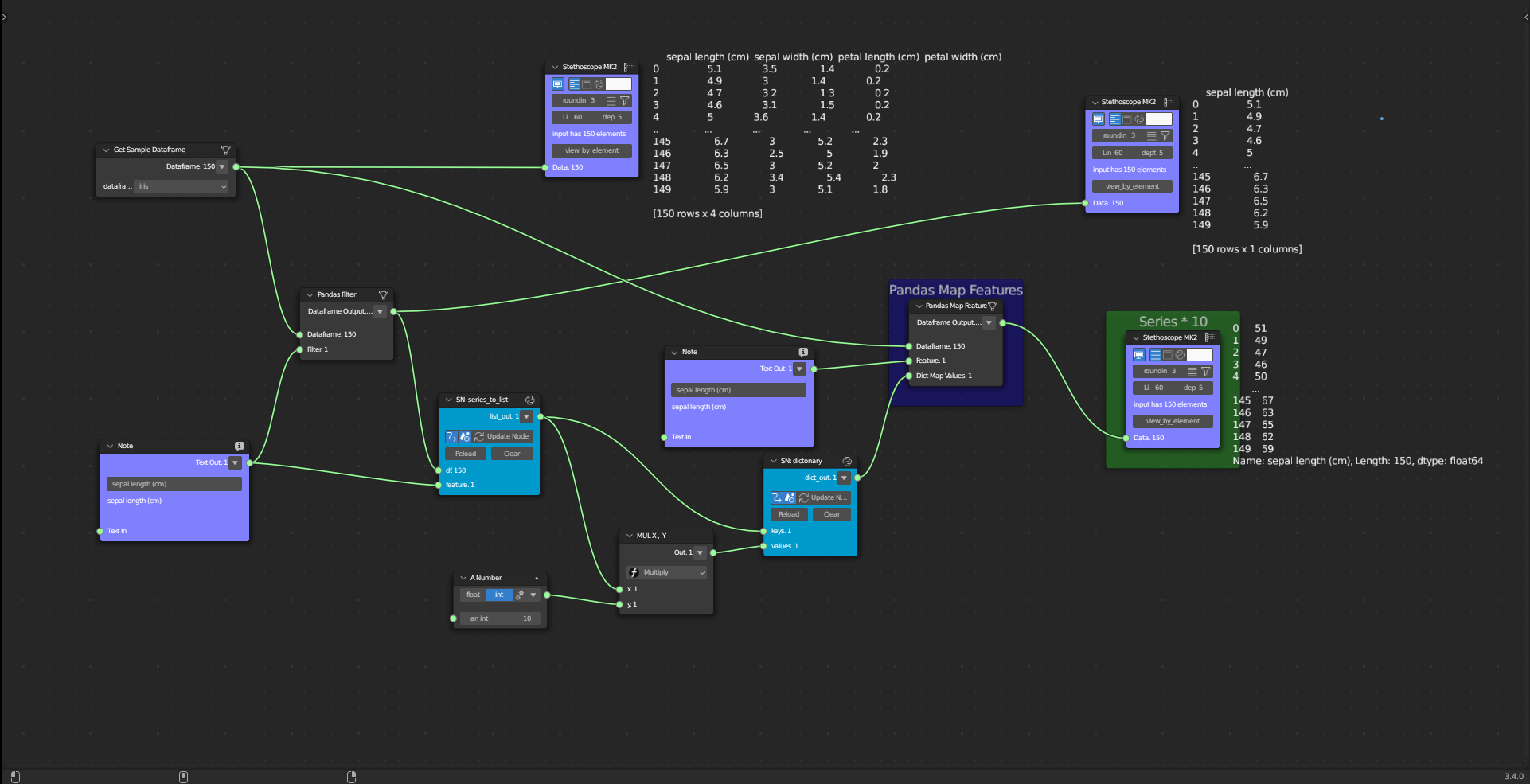
Assign weights
Map building types to weighting factors for analysis workflows.
Notes
- The mapping structure must be a valid dictionary.
- Values not present in the mapping may result in NaN.
- Works best for categorical transformations.
- Output follows Sverchok DataFrame wrapping conventions. ```