Correlation
Category: Mega-Polis → Analysis → Analysis Data Tools
Node ID:SvMegapolisCorrelation
Tooltip: Correlates a Dataframe using the methods; pearson, kendall, or spearman
Dependencies:pandas
Functionality
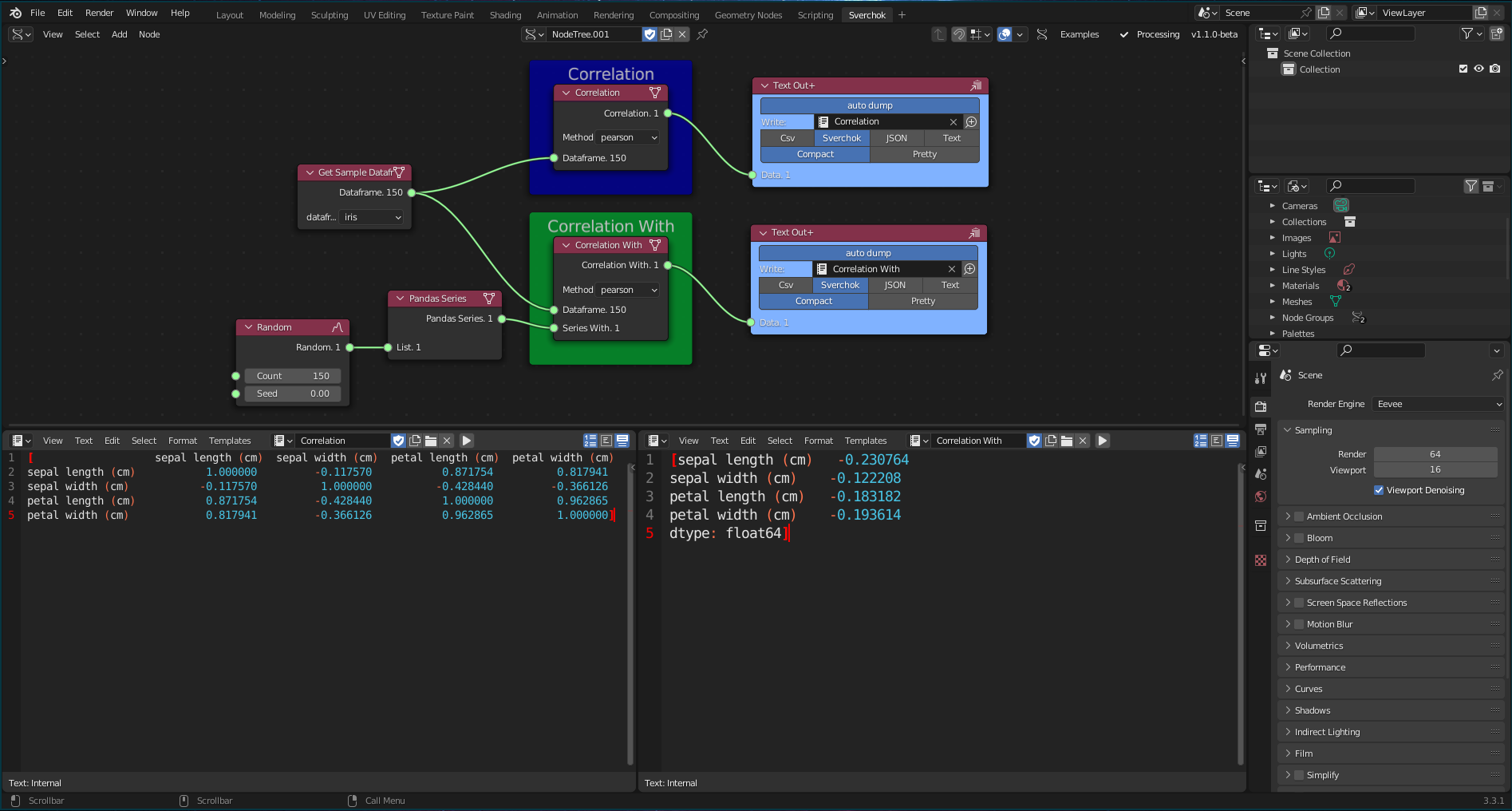
Computes a correlation matrix from an input Pandas DataFrame using df.corr(method=...).
You can choose the correlation method:
pearsonkendallspearman
The output is the resulting correlation DataFrame wrapped in a single-item list for Sverchok output.
Inputs
| Socket | Type | Description |
|---|---|---|
| Dataframe | SvStringsSocket | Input Pandas DataFrame. The node does nothing unless this socket is linked. |
Parameters
| Name | Type | Default | Description |
|---|---|---|---|
Method (correlation) |
Enum | pearson |
Correlation method passed to df.corr(method=self.correlation). |
Available methods
pearsonkendallspearman
Outputs
| Socket | Type | Description |
|---|---|---|
| Correlation | SvStringsSocket | Correlation matrix as a Pandas DataFrame (returned as [data]). |
Example
Compute Pearson correlation
- Prepare a Pandas DataFrame (e.g., from Read CSV →
CSV DF, or from any other node producing a DataFrame). - Connect it to Dataframe.
- Set Method to
pearson. - The output Correlation will be a DataFrame where each column is correlated against every other column.
Compute Spearman correlation (rank-based)
- Same setup as above.
- Set Method to
spearman. - Use the result for monotonic (rank) relationships.
Notes / gotchas
df.corr(...)only operates on numeric columns. Non-numeric columns are ignored by Pandas.- The output is wrapped as a list (
[data]). If a downstream node expects a raw DataFrame, you may need to unwrap it there (depending on your Sverchok data conventions). ```