Read LAS
Category: Mega-Polis → Gathering → Gathering Design Tools
Node ID:SvMegapolisReadLas
Tooltip: Read a LAS Point Cloud File
Dependencies:laspy,numpy
Functionality
Reads a LAS point cloud file using laspy, converts point coordinates into real-world XYZ values (applying LAS header scales and offsets), and outputs:
- 3D point coordinates (as Sverchok vertices)
- the decimated LAS point record data
- intensity values
- classification codes
- per-point RGBA colours derived from a built-in LAS classification palette
A subsampling_factor parameter allows you to reduce point count by taking every Nth point for performance.
Inputs
| Socket | Type | Description |
|---|---|---|
| Path | SvFilePathSocket | Path to a .las file. |
Parameters
| Name | Type | Default | Description |
|---|---|---|---|
| subsampling_factor | Int | 1 | Decrease the number of points by a factor. Uses Python slicing points[::subsampling_factor]. Minimum = 1. |
Outputs
| Socket | Type | Description |
|---|---|---|
| Points | SvVerticesSocket | Decimated point coordinates as (x, y, z) float values computed from LAS integer coords using header scales/offsets. |
| Points Data | SvStringsSocket | Decimated LAS point record (las[::subsampling_factor]). |
| Intensity | SvStringsSocket | Decimated intensity values (cast to uint32). |
| Classification | SvStringsSocket | Decimated classification codes (as a list). |
| Classification Colours | SvStringsSocket | Decimated RGBA colours per point, mapped from classification codes via an internal lookup table. |
Example
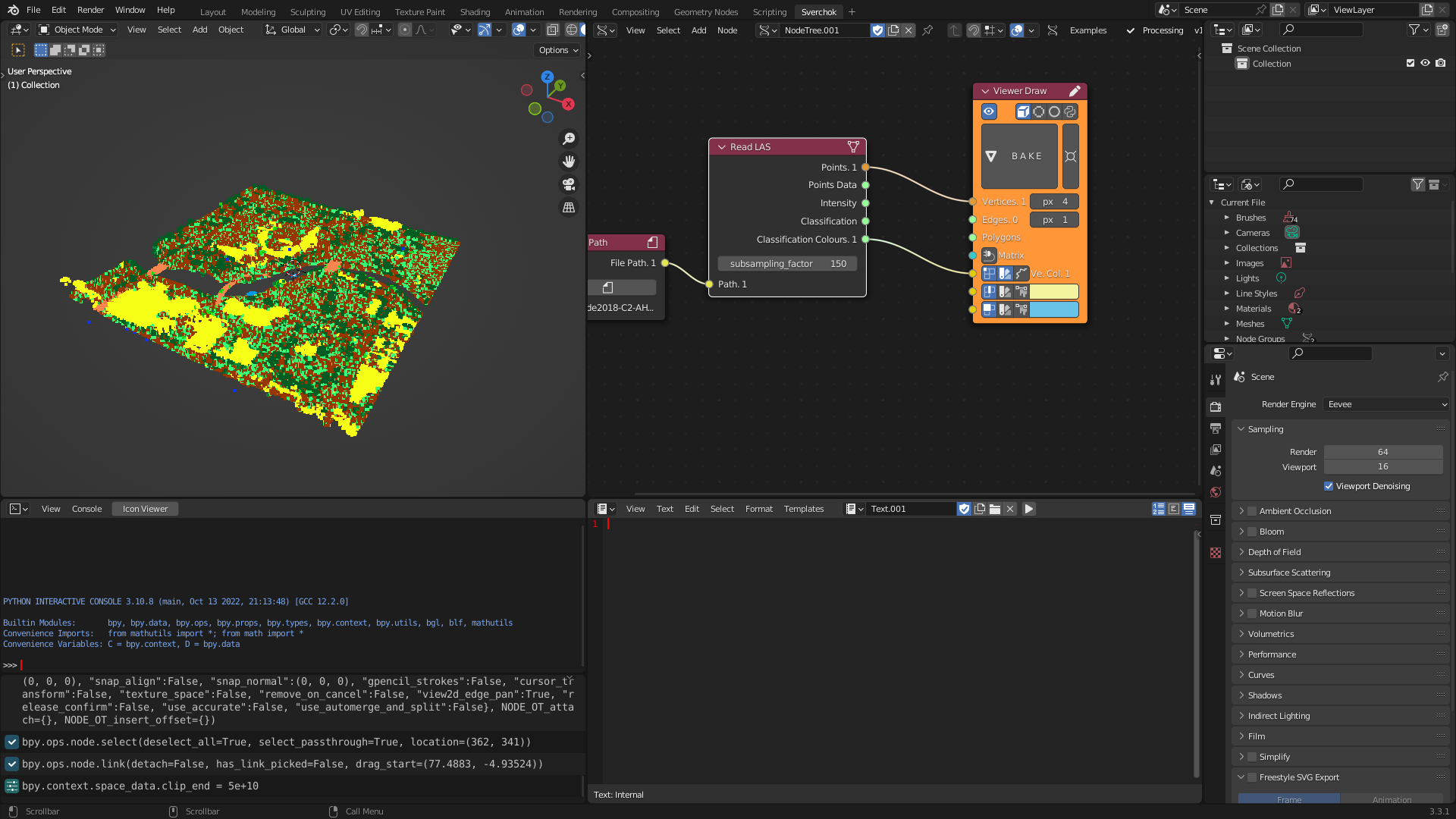
Minimal workflow
- Add Read LAS node.
- Connect a
.lasfile to Path. - (Optional) Set subsampling_factor to e.g.
10for faster previews. - Connect:
- Points → your point viewer / point-to-mesh workflow
- Classification Colours → viewer colour input (if available in your pipeline)
- Intensity / Classification → downstream filtering / analysis nodes
Notes
- Coordinate conversion uses:
X = las.X * scale_x + offset_x(same for Y, Z). - The classification colour palette is hard-coded in the node (common LAS classes like ground, vegetation, building, water, etc.).
- Very large LAS files can be heavy—use subsampling_factor early in the graph.